domingo, 8 de junio de 2014

UNIT  12 MIDDLE  AGES:  CHRISTIAN  KINGDOMS
Muslims were in the Peninsula for 800 years and they occupied the centre and south of the Peninsula.
But a few small, independent Christian kingdoms grew on the Cantabrian coast and in the Pyrenees.
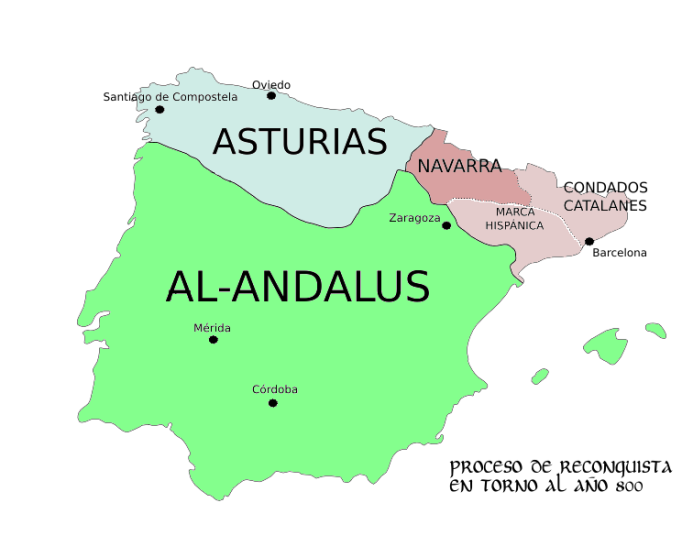
Christian kingdoms before the year 1000:
  • the Kingdom of Asturias was the first and later become the Kingdom of Leon
  • the Kingdom of Aragon
  • the Kingdom of  Navarra
  • the Catalonian Counties
  • the Kingdom of Castilla


Around 1230 the Peninsula was divided into several large kingdoms:
  • kingdom of Navarra: Navarra + La Rioja
  • Crown of Aragon: kingdom of Aragon + Valencia + Mallorca + Catalonian Counties
  • Crown of Castilla: kingdom of Castilla + kingdom of Leon + Andalucia (except from Granada)
  • Portugal


From the 13th to the 15th centuries, the Crowns of Castilla and Aragon conquered many Muslim territories and extended their borders. This is the map of the Peninsula around 1400:


In 1469 the Queen of Castilla, Isabel, and the King of Aragon, Fernando, married and united the Crowns of Castilla y Aragón.


In 1492, towards the end of the Middle Ages, The Catholic Monarchs conquered the Muslim Kingdom of Granada. This was the last remaining land belonging to the fMuslims. This completed the Christian Reconquest.


Society in the Christian Kingdoms was organized as a feudal system. It consisted of three social groups:
  • the noblemen: the king was the highest political authority. He gave land to the noblemen and they protected the king. They lived in castles.
  • the clergy: include bishops and monks. Monks lived in monasteries.
  • the peasants: most of them were serfs, they served a nobleman and gave some of the crops to him. Population in the cities were craftsmen an merchants.


In this picture you can see the relation between the social groups, their occupations and the kind of place they lived in:

 https://blogger.googleusercontent.com/img/b/R29vZ2xl/AVvXsEgrdfiAMBbEIntP3WT_Fqv8ZOwFSVtkRZXGtV1Vd8F8gCmqw7aG5ElMFHoP9AE45f1X9xCb57u4BFryd0P4hNqteuZMJE8nuo-H7i3EjYOu7sRj7txgNsGdbTPtcoH-V1pIRg5XREPnVhw/s640/15-3-la-baja-edad-media.jpg
 copied from a teacher´s blog: click on the picture

Medieval cities had a castle, a cathedral or church, a city hall, palaces and a marketplace. They were organized into neigbourhoods or districts and surrounded by walls which city gates were closed at night.

http://colegiolasrozassexto.blogspot.com.es/2014/04/tema-xiii-de-la-prehistoria-la-edad_9407.html
picture copied from a teacher´s blog: click on it

Here you have a picure of a monastery and its parts:

http://historiaeuropa.wordpress.com/2011/12/27/tema-3-la-cristiandad/
picture copied from a teacher´s blog: click on it

Look and identify the different parts of a medieval castle:


For more information you can visit this blog:


And also you can play with this presentation:


Interested in castles? Look at this digital book from a high school:

 http://www.iescavaleri.com/libro/index.php?section=9&page=-1

miércoles, 4 de junio de 2014

UNIT  12  MIDDLE  AGES:  MUSLIMS
  • In 711 A.D. Muslims entered the Peninsula from north Africa.
 
They conquered the south and centre of the Peninsula and named it AL ANDALUS.
They settled the capital in CORDOBA.


They were in the Peninsula for more than seven hundred years and along that time the organization of the territory changed:

http://ccss2eso.blogspot.com.es/2011_10_01_archive.html
copied from a teacher´s blog: clic on the picture

In the 11th century, the Christian Kingdoms in the north of the Iberian Peninsula conquered many Muslim territories. As a result, Al Andalus was divided into small kingdoms called TAIFAS. The taifa kingdoms fought each other continuously.

Taifas kingdoms in 1031

Christian kingdoms fought against the Muslims for over seven centuries and eventually unified into four big Christian kingdoms.


Muslims brought their customs, laws and religion. The highest authority was the caliph:


They lived in cities protected by walls, on hills. They built palaces and mosques and worked as merchants and craftsmen.

http://conocimientoaguilar.blogspot.com.es/
copied from a teacher´s blog: click on the picture

An important palace is the Aljaferia in Zaragoza:


The Great Mosque of Cordoba was also very important:


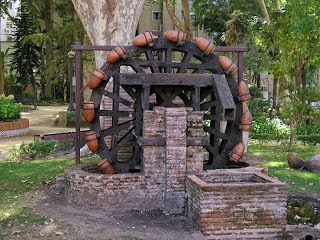
They improved the techniques in crop farming with the invention of the water wheel and the irrigation ditches:


Al Andalus society was divided into groups:
  • Muslims: the most powerful, held positions in the government and owned the best land. They practised Islam religion and worshipped in mosques.
  • Christians and Jews paid a tax to the Muslim rulers, but they also played important roles in society and culture.


Here you have an example of a Muslim house and the public baths, both of them copied from a teacher´s blog. Click on the pictures for further information:

http://www.juanjoromero.es/blog/2009/01/u6-al-andalus/     http://www.juanjoromero.es/blog/wp-content/uploads/Ba%C3%B1o-arabe.png 


jueves, 29 de mayo de 2014

STUDENT´S  PROJECTS:  ROMAN  HISPANIA