The Rock Cycle is the term applied to the continuous process that describes how rock material
forms, erodes, changes and is eventually recycled. The process is nonlinear, material can move
throughout the cycle through erosion, compaction, partial melting or complete melting. There is
no set pattern or sequence that must be followed nor a set duration that rocks will remain in one
form or another. The three forms of solid rock are sedimentary, metamorphic and igneous.
Let´s see an animated rock cycle (click on the picture):
Another amimated cycle and a game in this website:
jueves, 16 de enero de 2014
UNIT 6 EARTH´S INTERIOR
There is an enormous amount of energy inside the Erth. This energy can cause:
volcanic eruptions
earthquakes
mountain ranges to emerge
VOLCANOES
A volcano is an opening, or rupture, in the surface or crust of the Earth or a planetary mass object, which allows hot lava, volcanic ash and gases to escape from the magma chamber below the surface.
all this information in the website below:
Volcanoes are formed when magma from within the Earth's upper mantle works its way to the surface. At the surface, it erupts to form lava flows and ash deposits. Over time as the volcano continues to erupt, it will get bigger and bigger.
Here you have an easy video explaining what a volcano is:
Listen to the music and see these amazing images:
And now, let´s learn a bit more with pop music:
If you want to see more videos, click on this website:
EARTHQUAKES
An earthquake (also known as a quake, tremor or temblor) is the result of a sudden release of energy in the Earth's crust that creates seismic waves. The seismicity, seismism or seismic activity of an area refers to the frequency, type and size of earthquakes experienced over a period of time.
This diagram shows an earthquake along a fault. The focus of the
earthquake is where the energy is released underground. The epicenter is
the spot on the Earth’s surface directly above the focus.
information copied from:
Here you have some videos about earthquakes:
What is a tsunami?
A tsunami is a large ocean wave usually caused by an underwater earthquake or a volcanic explosion. Tsunamis are NOT tidal waves. Tidal waves are caused by the forces of the moon, sun, and planets upon the tides, as well as the wind as it moves over the water. With typical waves, water flows in circles, but with a tsunami, water flows straight. This is why tsunamis cause so much damage
UNIT 6 EARTH´S CRUST
The activity in the environment causes changes in the Earth´s surface. The processes involved are:
weathering
erosion
transport
deposition
Transport refers to the processes by which the sediment is moved along – for example, pebbles rolled along a river-bed or sea shore, sand grains whipped up by the wind, salts carried in solution.
Erosion and transport by wind.
Erosion and transport by ice.
Erosion and transport by water.
Deposition is the laying down of sediment carried by wind, water,
or ice. Sediment can be transported as pebbles, sand & mud, or as
salts dissolved in water. Salts may later be deposited by organic
activity (e.g. as sea-shells) or by evaporation.
viernes, 10 de enero de 2014
UNIT 6 BIOSPHERE
The biosphere is all the living things on Earth. It is the global sum of all ecosystems. Living things interact with the other spheres. Plants and animals depend on the physical environment for the basics of life. They also help to mantain an alter their phusical environment.
The biosphere is the “zone of life,” consisting of all of Earth's living things
and their environments. It is not really a separate sphere from the
others but includes parts of all three. Life obviously occupies the
oceans and the surfaces of the continents, but it also exists in the
atmosphere.
UNIT 6 ATMOSPHERE
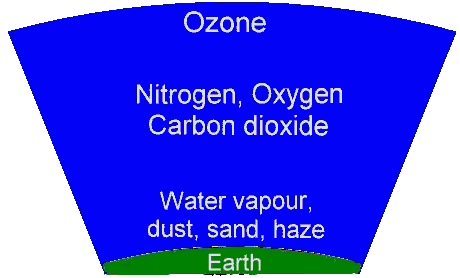
The atmosphere is the layer of gases surrounding the Earth.
It is essential for life because:
it provides air and water
it keeps the Earth warm
is protects from harmful radiation
The Earth's atmosphere comprises a layer of gases retained by the Earth's
gravity. It contains roughly:
78% nitrogen
21% oxygen
0.9% argon
0.04%
carbon dioxide
trace amounts of other gases
and a variable amount
(average around 1%) of water vapour.
This mixture of gases is commonly
known as air. The atmosphere protects life on earth by absorbing
ultraviolet solar radiation and reducing temperature extremes between
day and night.
The atmosphere is divided into five layers:
troposphere: the first layer above the surface and contains half of the Earth´s atmosphere. Weather occurs in this layer.
stratosphere: the layer above the troposphere. Many jet aircrafts fly in this layer because it is very stable. The ozone layer absorbs harmful rays from the Sun.
mesosphere: it is the layer in which meteors or rock fragments burn up.
ionosphere: it is the layer with auroras. Space shuttles orbit in this layer.
exosphere: it is the upper limit of our atmosphere.
jueves, 9 de enero de 2014
UNIT 6 HYDROSPHERE
The hydrosphere is all the water on the Earth. We can find water in the three states:
solid: snow, ice
liquid: oceans, seas, rivers, lakes
gas: water vapour
The water cycle represents the constant circulation of water between the Earth´s surface and the atmosphere:
Here you have an interactive lesson and game about the water cycle:
UNIT 6 GEOSPHERE
The gosphere is the rocky part of the Earth. It is made up of three layers:
crust
mantle
core
click on the picture to see this interactive Earth:
Do you want to compare the Earth with an egg or an apple? click on the picture:
Remember that the geosphere is the rocky part:
Read more information about the Earth´s layers on this website:
UNIT 6 THE EARTH The Earth is a terrestrial planet, this means that it is made up mostly of rocks rather than gas (as Jupiter). It is the largest of the four terrestrial planets in size and mass. Terrestrial planets are inner planets. The Earth consists of four spheres:
geosphere
hydrosphere
atmosphere
biosphere
If you want to read more information click on the pictures and visit the different spheres.
If you want to see the four spheres in a real picture, click on the image below:
Learn more about Earth´s spheres, click on this animated gif: