This video summarizes the most important ideas of this unit:
Mostrando entradas con la etiqueta UNIT 3 Plants. Mostrar todas las entradas
Mostrando entradas con la etiqueta UNIT 3 Plants. Mostrar todas las entradas
martes, 5 de noviembre de 2013

miércoles, 30 de octubre de 2013
UNIT 3 FLOWERING PLANTS REPRODUCTION
Flowering plants can be classified into gymnosperms and angiosperms.
- GYMNOSPERMS have small flowers but no fruit. Their seeds are all together in cones.
- ANGIOSPERMS have flowers and fruits.

SEXUAL REPRODUCTION IN PLANTS
The reproduction process is a cycle (no beginning no end).
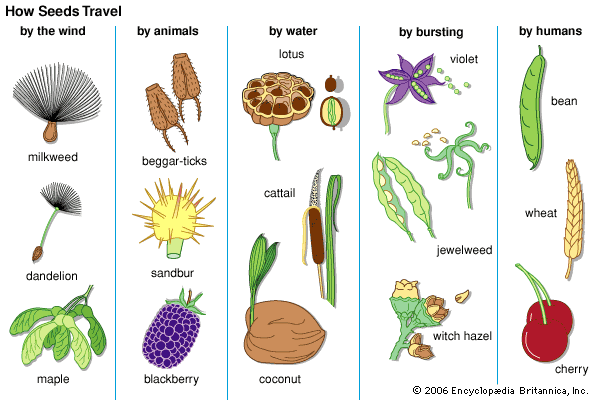
Flowers are the reproductive organs in which pollen and ovules are formed. Polen and ovules mix in an act called pollination and the flower transforms into a fruit. Fruits contain the seeds. Seeds fall to the soil and germinate that is, a new plant can grow.

Flowers
Flowers generally are the showiest part of a plant. Their beauty and fragrance attract pollinators (insects or birds) that play an important role in the reproductive process.
.jpg)
If you want to play a question game about flowers, click on the picture.
Pollination
Pollination is the movement of pollen from the stamens to the ovary. It usually takes place in the same plant. However, wind and insects also carry pollen to other plants.

This is a simple video about pollination:
Fruit and seeds
Fruit is the fleshy structure of certain plants that may be sweet and edible in the raw state, such as apples, oranges, grapes etc. It also consists of seeds which are for propagation of plant. The seed contain food which supplies energy and materials for growth until the plant grows its first leaves above the ground.

Let´s see an interesting video about fruit development:
Do you want to see the germination of a seed? Watch this video:
A fantastic video filming the process from an acorn to an oak:
ASEXUAL REPRODUCTION IN PLANTS
Some plants reproduce without flowers or seeds.


Now, you can see a video about asexual reproduction in plants:
domingo, 27 de octubre de 2013
UNIT 3 PLANT NUTRITION
Nutrition is one of the basic life processes to all living things. The nutrients that living things obtain provide energy to the organism.
Remember thar nutrition includes to breathe and to eat.
- to BREATHE: exchange of gases in an organism, it is also called RESPIRATION. Plants take oxigen (O2) from the air and release carbon dioxide (CO2), exactly like people do. Plants need to breathe all day and night, exactly like people do.
- to EAT: plants are autotrophos, this means that they can make their own food. The process in which plants make their food is called PHOTOSYNTESIS. Photosyntesis only occurs during the day because it is necessary sunlight.

Here you have an easy video about this process:
UNIT 3 PLANT SENSITIVITY

 Here you have some short videos about plant sentitivity:
Like animals, plants sense changes in their surroundings and respond to them. Plants are able to detect and respond to light, gravity, changes in temperature, chemicals, and even touch. Unlike animals, plants do not have nerves or muscles, so they cannot move very fast. A plant usually responds to change by gradually altering its growth rate or its direction of growth. The slow movements that plants make towards or away from a stimulus, such as light, are known as tropisms.

This information has been copied from this web:
- Mimosa reacting when is touched
- Venus flytrap in action
- Prayer plant
- 10 amazing plants
lunes, 21 de octubre de 2013
UNIT 3 PLANT CLASSIFICATION

This chart compares the ways in which mosses, ferns, gymnosperms, and angiosperms have adapted to a land environment.

The following information is taken from a beautiful blog named:
GYMNOSPERMS


FERNS
Ferns develope in wet and seasonally wet environments like tropical rainforests. Ferns have specialized tissues called vascular tissues. These tissues transport water and products of photosynthesis throughout the plant. Ferns have true roots, stems called rhizomes, and large leaves called fronds.

Plant kingdom can be broadly classified into two types based on their reproductive system.
- Spore bearing plants
- Seed bearing plants
The following flow diagram shows you how plants are classified based on this criteria.

This chart compares the ways in which mosses, ferns, gymnosperms, and angiosperms have adapted to a land environment.

The following information is taken from a beautiful blog named:
Gymnosperms literally means "naked seed". In gymnosperms a number of their leaves have evolved into scales. These scales are used in reproduction. Scales are grouped into larger structures called male and female cones. Fertilization is by pollen, not from mobile sperm.The female cones produce the eggs, while the male cones produce the pollen. Gymnosperms are the most ancient surviving seed plants.

ANGIOSPERMS
Angiosperms are
flowering plants, that only reproduce sexually through pollination taking place
in flowers. Seeds of angiosperms are contained within a protective barrier
called a fruit.
MOSSES
Mosses need to live in a wet environment to survive. They
develope and grow most abundantly in bogs, swamps,
moist woods, and near streams. Mosses vary in appearance, but most are less than a few centimetres tall. They haven´t got the water conducting tubes that are found in more complex plants and also they haven´t got true roots, stems or leaves.

FERNS
Ferns develope in wet and seasonally wet environments like tropical rainforests. Ferns have specialized tissues called vascular tissues. These tissues transport water and products of photosynthesis throughout the plant. Ferns have true roots, stems called rhizomes, and large leaves called fronds.

UNIT 3 PLANTS

Plants are living organisms such as trees, herbs, bushes, grasses, vines, ferns, mosses, and green algae.
They provide us with food materials, wood and also convert carbon monoxide into life giving oxygen.
They are composed of many parts such as roots, stem, leaves, buds, flowers, fruits etc.
MAIN PARTS IN A PLANT

Root: roots originate from the lower portion of a plant and they are in the soil. Their functions are to absorb nutrients and moisture, anchor the plant in the soil, support the stem, and store food such as carrots. In some plants, they can be used for propagation.
Stem: the stem is the upper part of the plant and bears branches, leaves, flowers and fruits. Stem is generally green when young and later often become woody and dark brown. It conducts water and minerals from the root to the leaves. Some stems perform the function of storage of food for example potato.
Leaves: leaves provide trees with all their food because they turn sunlight into food energy through photosynthesis. Leaves also make the oxygen in the air that we breathe.
domingo, 20 de octubre de 2013
UNIT 3 PLANTS LIFE PROCESS

Life is all around us, wherever we look we see living things like animals and plants.
Animals live because they grow, reproduce and move around to survive and protect themselves. There are many kinds of plants like seaweed, ferns and moses and flowers. They may not move in the way animals do but they grow and produce baby plants.
All organs carry out the life processes.
This will be described using one organism called the mimosa pudica also known as the shy and bashful plant.

All this information has been copied from this blog:
Plants- Life Process
Maybe you can find it very interesting.
Maybe you can find it very interesting.
Suscribirse a:
Entradas (Atom)